Lately I have been trying to get a story down. I do not yet know whether it will become a novel, a long story or only a test of voice, but this first piece seems complete enough to stand on its own: a drive home after a match, and the moment when a victory begins to look like a defeat.
Return
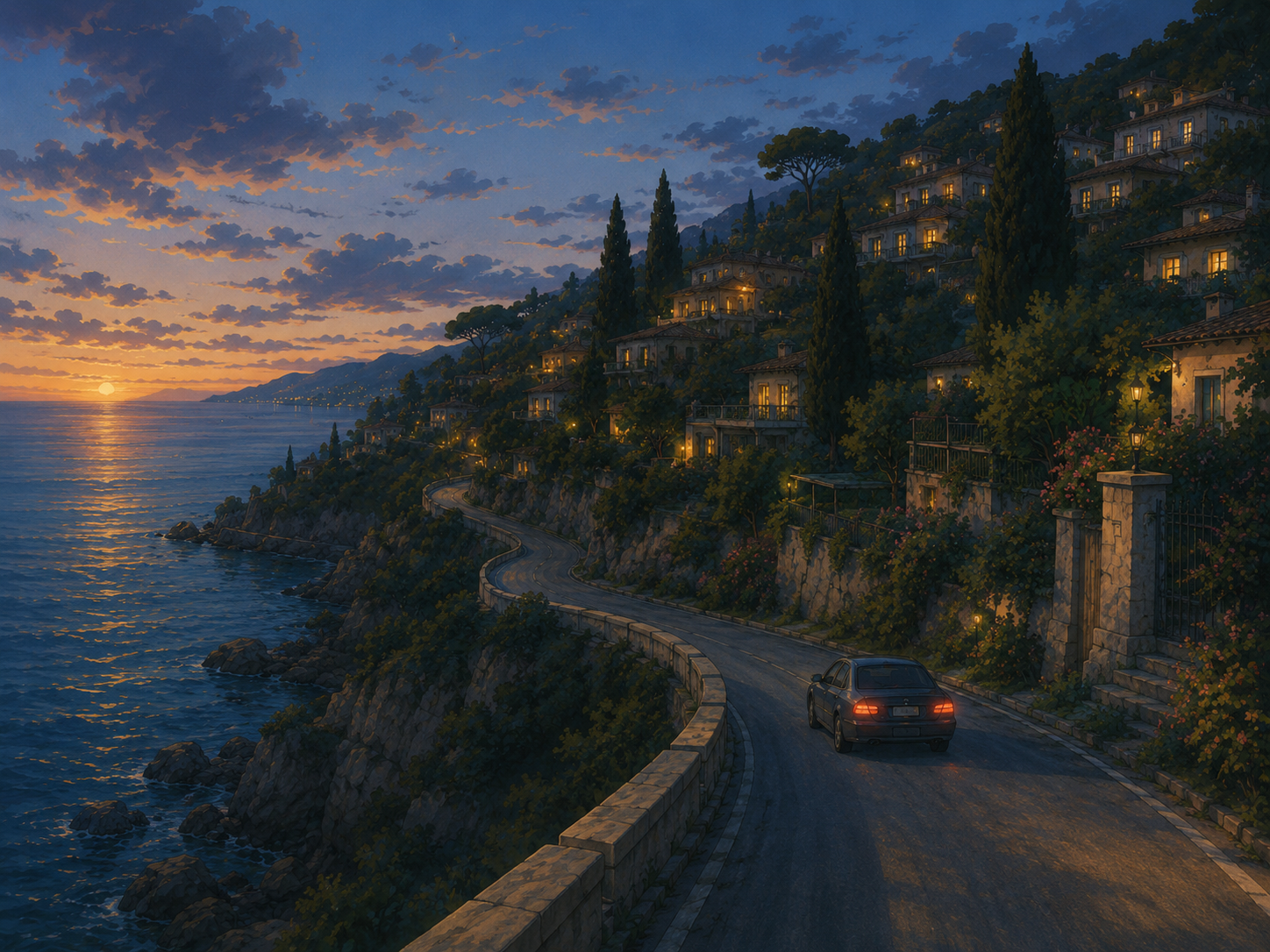
I drive back from the club with the racket on the passenger seat, still warm with sun and clay, the grip damp under my fingers, and for a few minutes, while the BMW glides along the high road of Monteluce with the engine coughing softly, politely, almost ashamed of its own power, I can pretend that evening is a simple thing: the sky above Capo Vero is a late blue, still lit behind the terraces, the villas climb the hillside like domesticated and very expensive animals, the sea below gathers the last light with the servile air of a great mirror placed there to reassure people who already have everything, and I have won.
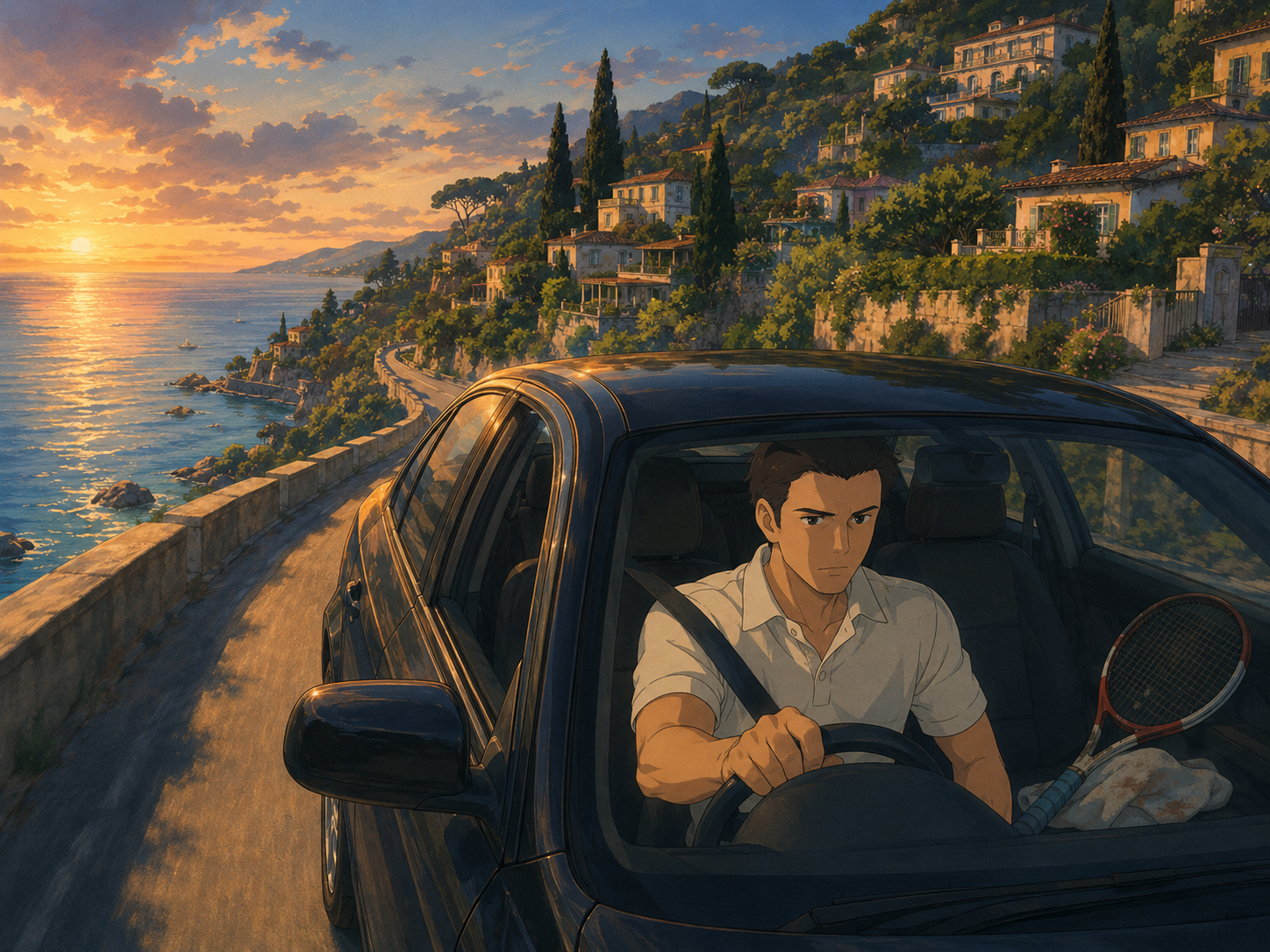
Not “played well”, not “held my own”, not one of those charitable formulas with which powerful men pretend to be sporting when they have just witnessed an error of nature; I really won, six-love, six-two. In the second set I left him those two games the way one leaves an overly visible tip to a waiter who despises us: not out of kindness, but from fear that humiliation, if too pure, might become recognizable.
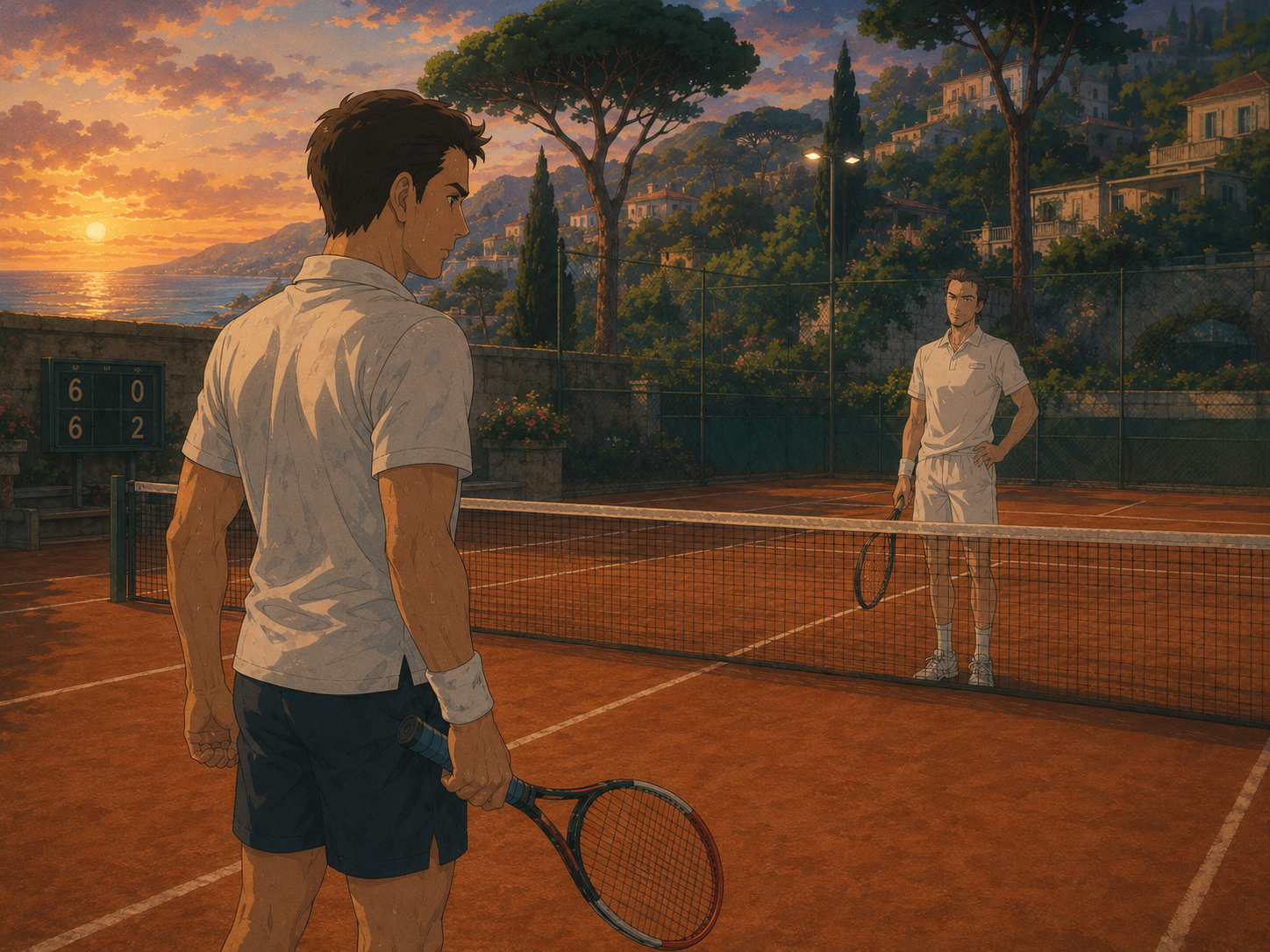
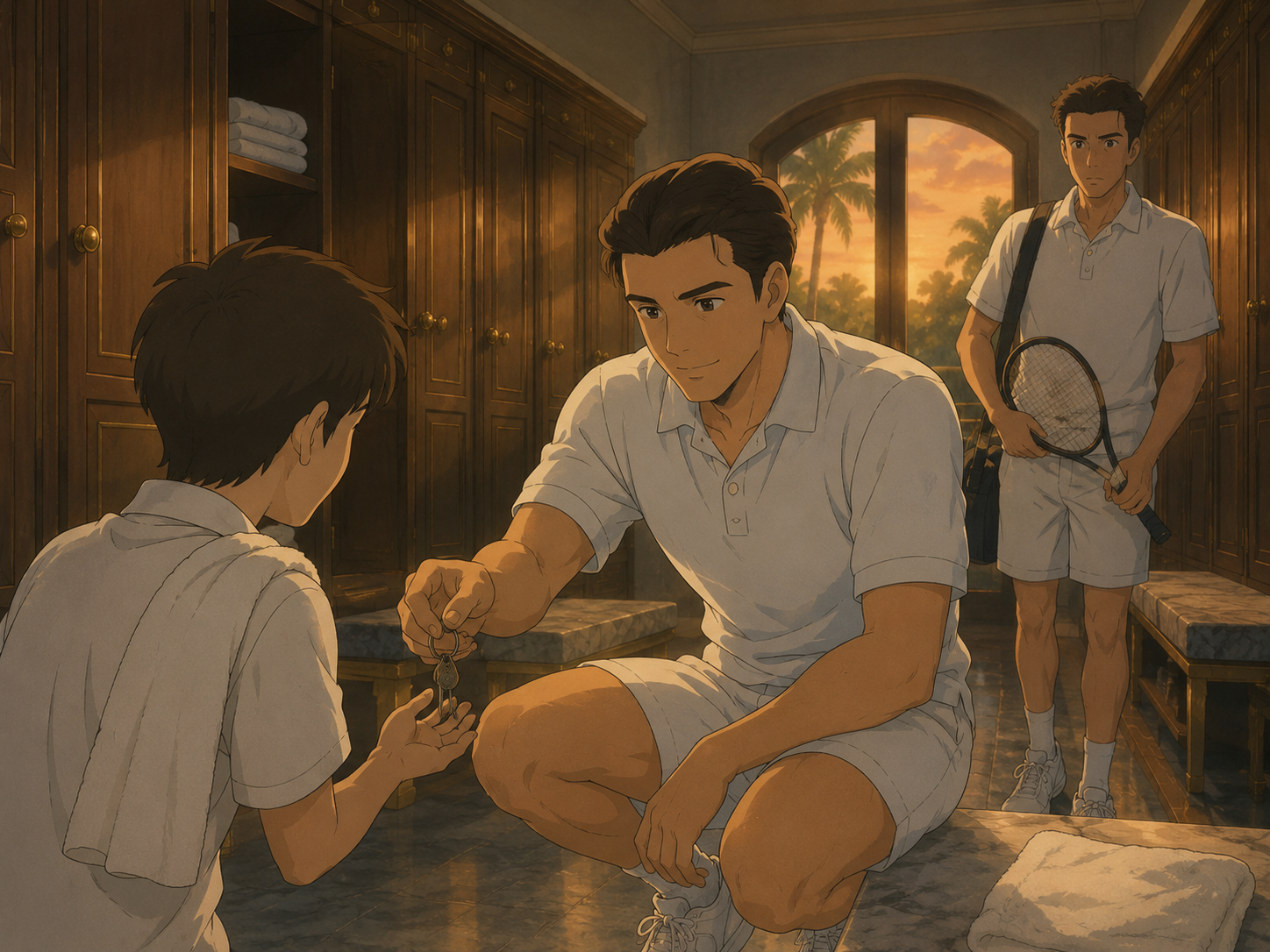
Lucian Reuss smiled until the last point, that much must be granted; he smiled with that thin, polished face of a Calvinist saint who had survived a bank merger, with blue veins at his temples, the white polo without a crease, the still, absent eyes of someone who has learned to let reality pass through him without really touching it, perhaps through discipline, perhaps through ketamine, perhaps because at a certain level of income even consciousness becomes an outsourced function. Before wounding me, though, he did something almost good: in the locker room he picked up the bunch of keys the towel boy had dropped and handed it back to him by name, asking whether his mother was doing better. There was no audience. The kindness seemed real. That, instead of absolving him, made him harder to hate.
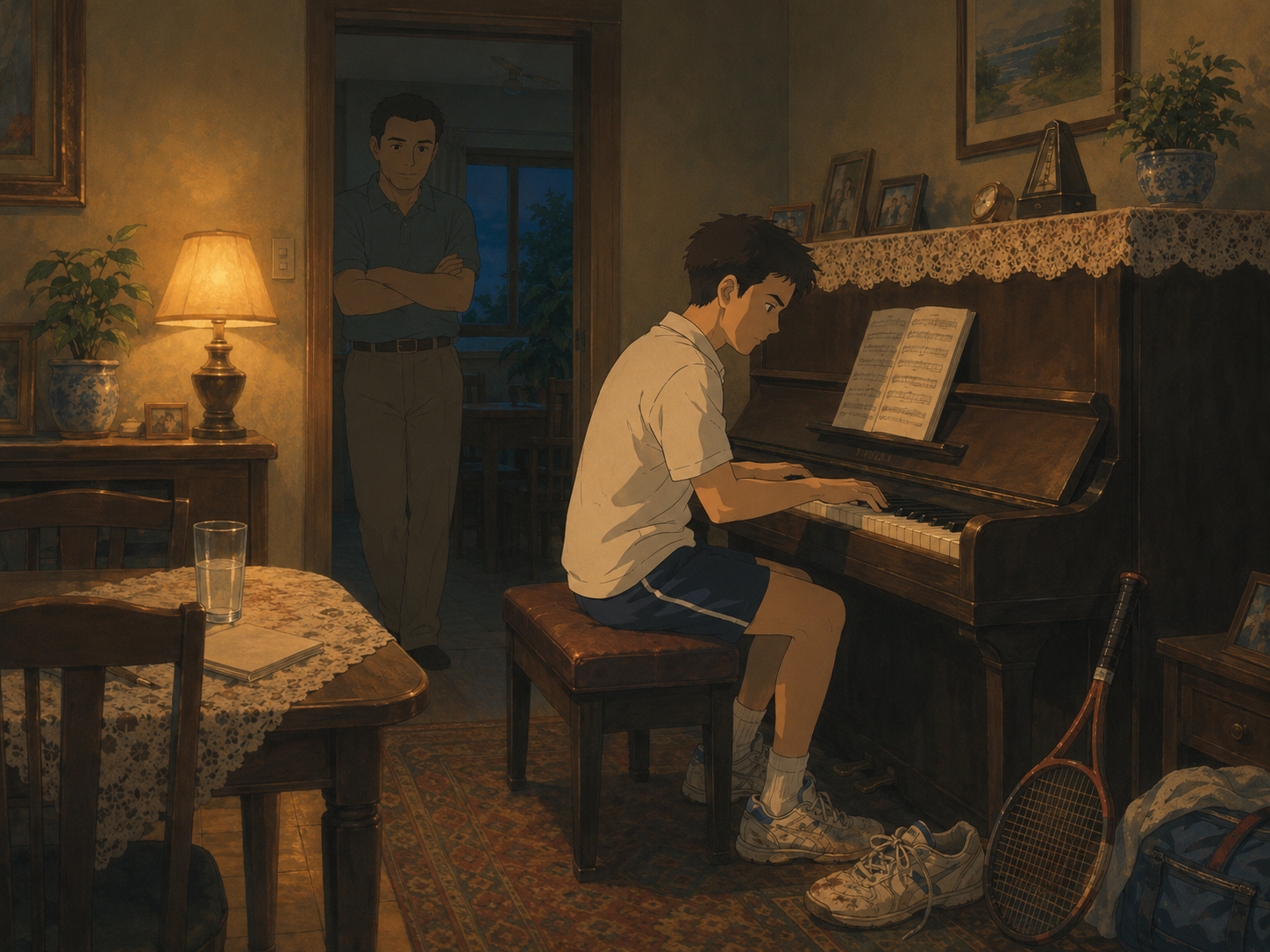
I watched him search for an explanation in miserable details: the light, the grip of the racket, the tension of the net, his shoulder, a dinner too heavy, bad sleep, a message that arrived before the match; everything except the simplest hypothesis, namely that I, Ross, still had in my arm an old, idiotic, useless talent, the talent of a fifteen-year-old boy who once knew how to send a ball wherever he wanted and then went home to play Bach on an upright piano bought in installments, before his father explained to him, not without tenderness, that the world does not pay men to be beautiful in motion, it pays them to be necessary.
Since then I have done what was necessary: I studied, I worked, I married Camille, I bought a house that in any other city would have been mentioned with respect, eight hundred thousand euros of pale walls, glass, garden, local stone and an oblique view of the sea, I have a high-powered BMW, an apartment downtown that I rent to noisy and sincerely poor students, a family that loves me and that I love with a form of devotion so serious it frightens me. And yet, as soon as I pass the bend of the cypresses and the first houses of Capo Vero light up one after another, my entire life begins to shrink. The BMW becomes an almost administrative vehicle; the house, a temporary solution; the work, a subordinate position with reserved parking.
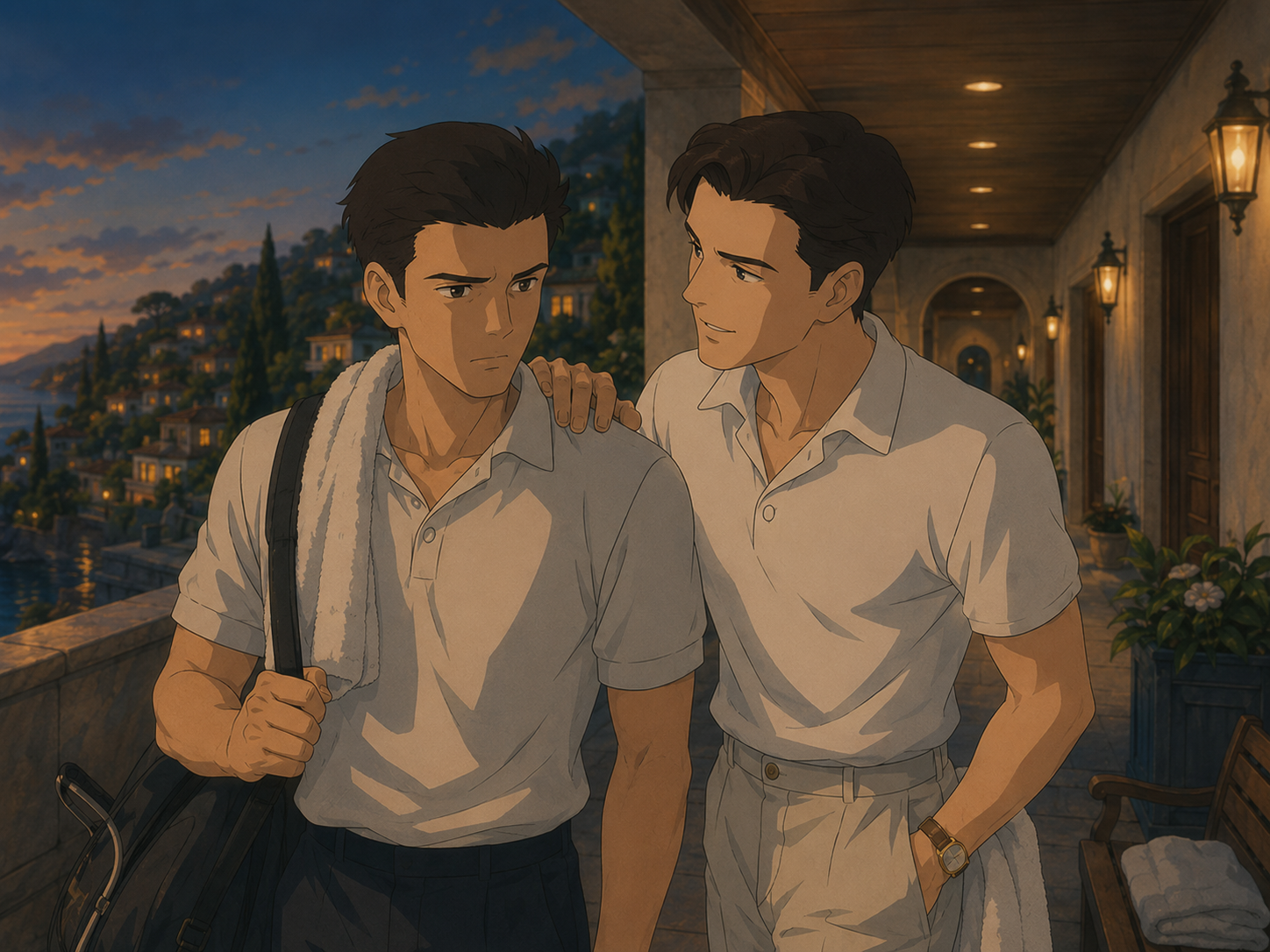
Lucian is one of them, not the owner, of course: no one is ever the owner in Capo Vero, there is always someone above, a more opaque father, a farther fund, a foundation in Liechtenstein, an old man with transparent skin who also owns the silence of people. But he is close enough to the summit not to have to be kind except when kindness costs him less than contempt. That is why, when he placed a hand on my shoulder, light as a diagnosis, and said I had a backhand “almost indecent for a man with such a sensible life”, I understood that the match had ended only for me.
He spoke of Camille without naming her right away, as elegant men do when they want to be vulgar but do not want to give up the protection of syntax. He said some women have “a fidelity to light”, that they do not age but “become more precise”, that certain industrial families produce daughters the way they produce brands: with absolute control of surface and a certain cruelty in the distribution of inheritance. Then he smiled, dried his neck with the club towel, and added that I must be a “very disciplined” man to live beside such a woman without turning into a poet, an alcoholic or an idiot.
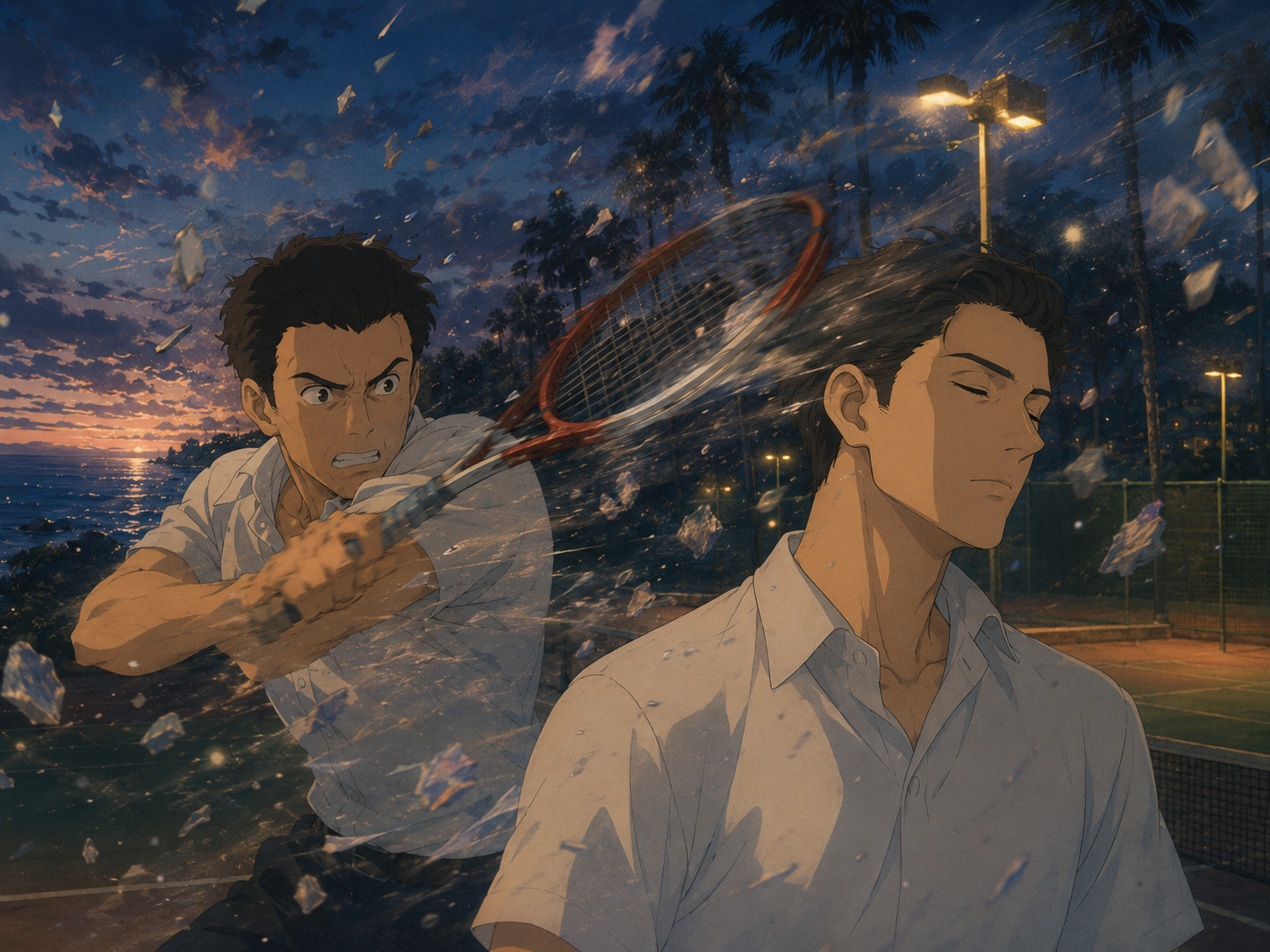
It was not a threat, naturally. In Capo Vero threats are considered a form of bad taste; allusions are preferred, because an allusion is violence that keeps the tablecloth clean. I laughed. I produced a short, competent, socially useful sound. I said something about marriage, perhaps about luck, perhaps about discipline, I do not remember; I only remember that, while I spoke, I imagined my racket breaking with marvelous precision against his left cheekbone, not to kill him, not even really to hurt him, but to finally introduce into his face an argument that could not be financed.
Then I was ashamed, because shame is the bourgeois residue of murderous instinct, and I am, in every cell that matters, a bourgeois man: I still believe in receipts, good schools, signed contracts, annual medical checkups, thank-you notes written well, curtains washed before summer. I leave the club and the air is so beautiful it seems innocent. The hill smells of jasmine, resin, expensive aftershave and automatic irrigation, as if nature here had accepted a consulting contract.
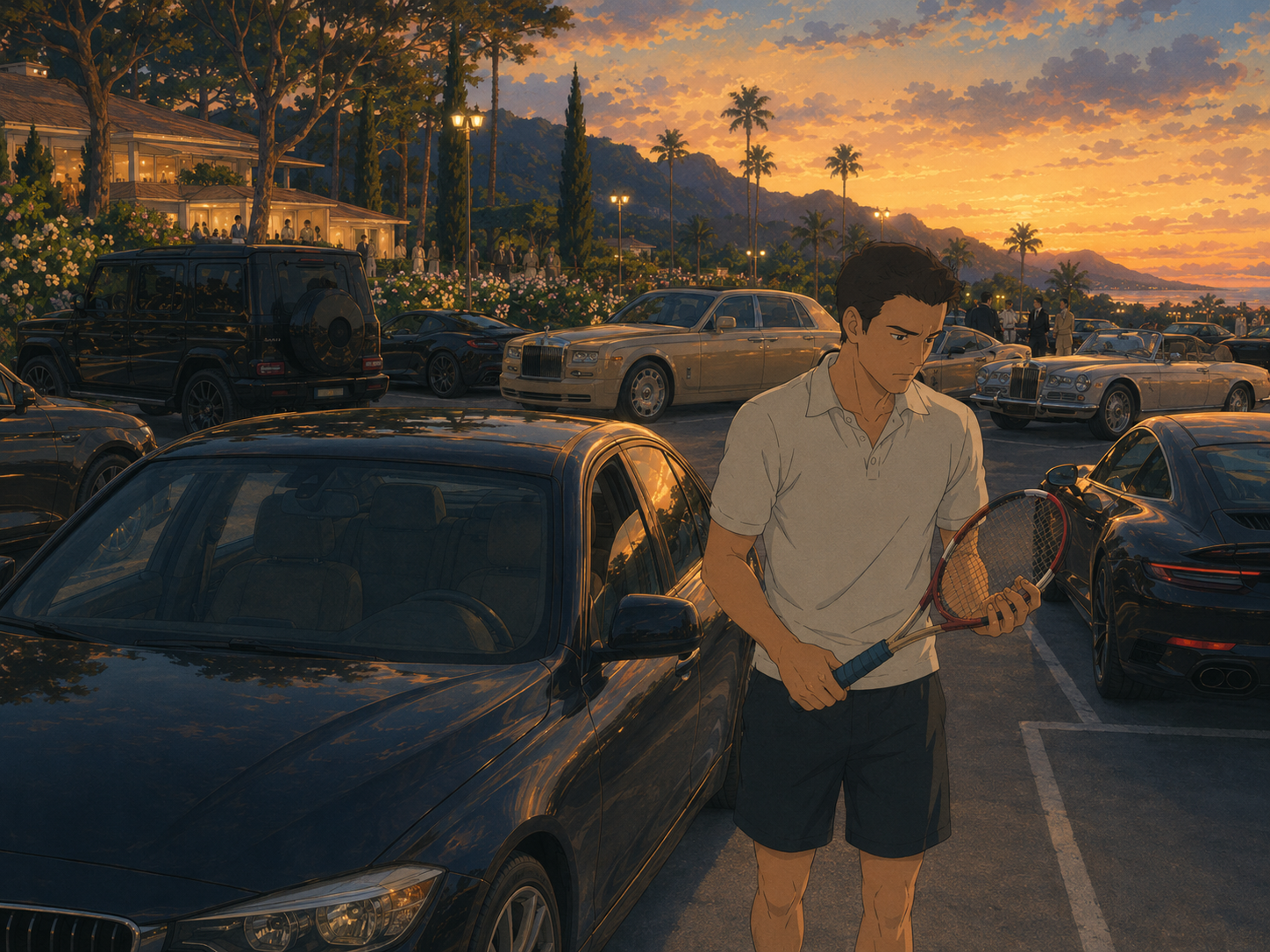
For a moment, before starting the engine, I sit still in the parking lot and look at the other cars: black electric Porsches, armored Range Rovers, a champagne-colored Bentley, two Chinese SUVs with obscene prices and childish names, an old Mercedes cabriolet worth more than my downtown apartment. My BMW is clean, splendid, powerful; it disgusts me with a violence I know to be unjust, and precisely because I know it is unjust it disgusts me even more.
Reason may also file its report: Ross, thirty-five, married, healthy, well-off, owner of two properties, father. A fortunate man by every statistical parameter of Western decency. But the body does not read statistics. The body reads looks, pauses, invitations that arrived late, seats assigned near the kitchen during Camille’s family dinners, the way her brother pronounces “work” when he speaks of mine, as if it were a necessary but slightly vulgar phase of existence.
It registers Lucian losing six-love and then speaking to me about my wife as if he were evaluating an acquisition not yet announced. It registers his pupil too wide, the smile of a chemical ascetic, the spectral elegance of someone who no longer desires things because things have learned to come to him. It registers the fact that I, the winner, am driving home with my throat closed, while he will already be under a warm shower, seated on the marble bench, without even granting me the honor of a durable hatred.
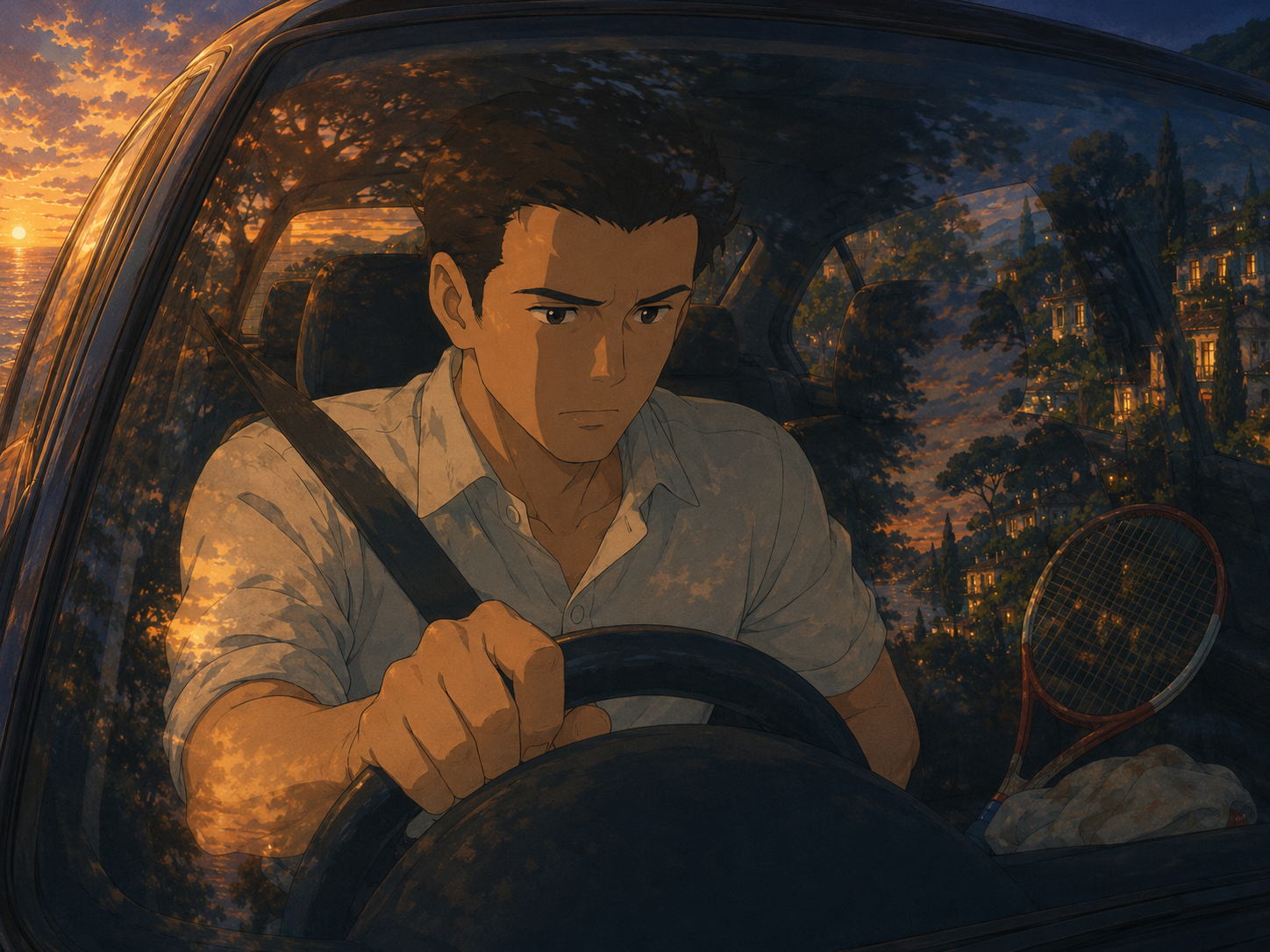
There are men who humiliate you without remembering it. They humiliate you as they breathe, as they park, as they order caviar at a charity dinner for diseases they would not know how to pronounce, already looking past you toward the next lit room. I, instead, remember everything. I remember phrases, tilts of the neck, smells, figures, the order of glasses at dinner, the color of a woman’s nails when she laughs because her husband has said something cruel but formally impeccable.
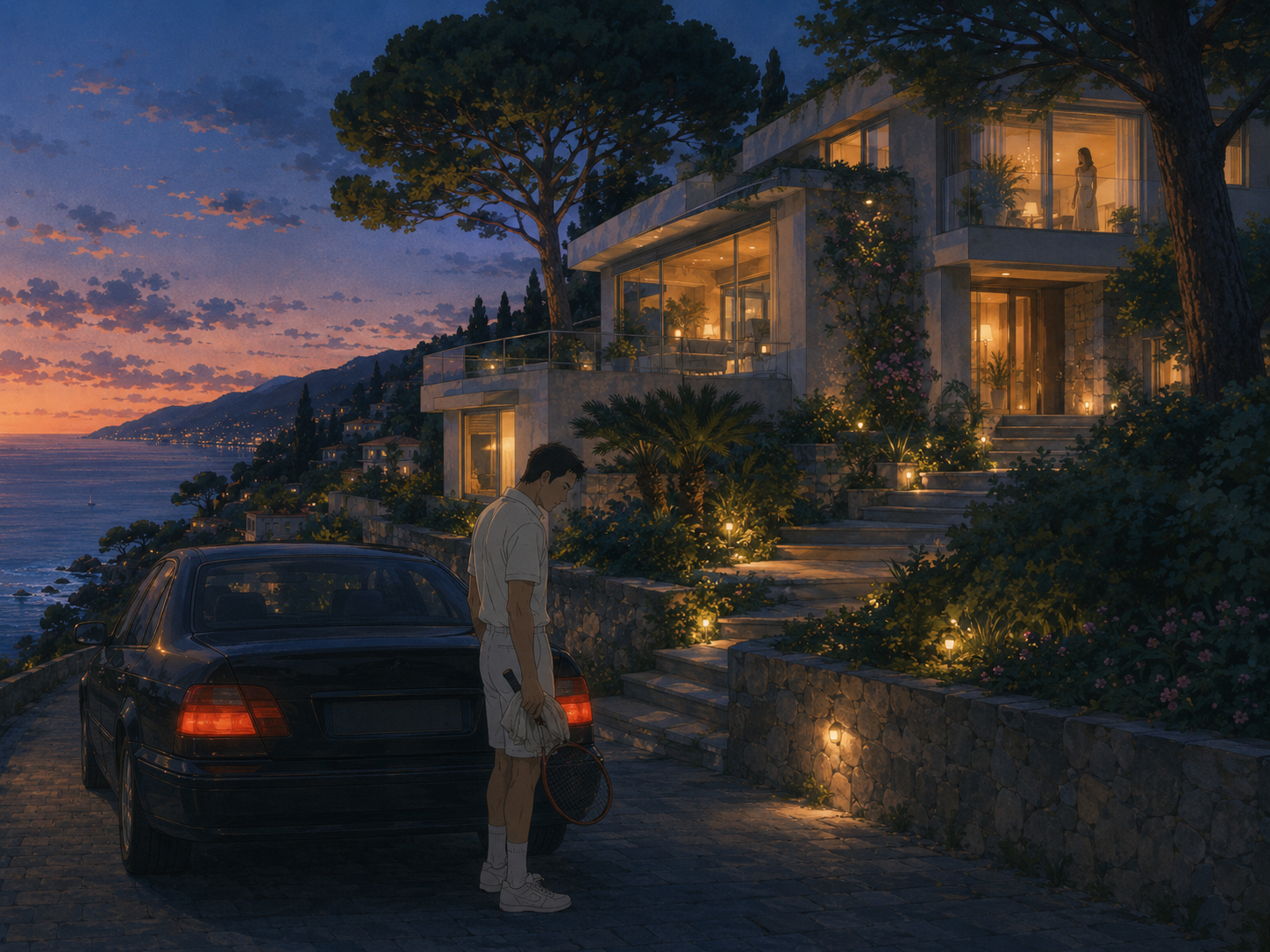
The evening continues to be magnificent. That is the worst part. Monteluce shines with the pornographic serenity of places that ask no forgiveness: the tall windows reflect the gold of sunset, the maritime pines draw noble shadows across the windshield, the stone walls guard gardens where no leaf ever seems to die without authorization. Who could pity me, seeing me now? A man tanned by tennis, in a polished BMW, driving back toward a luminous house, to a wife named Camille. One would have to be mad to pity me. One would have to be me.